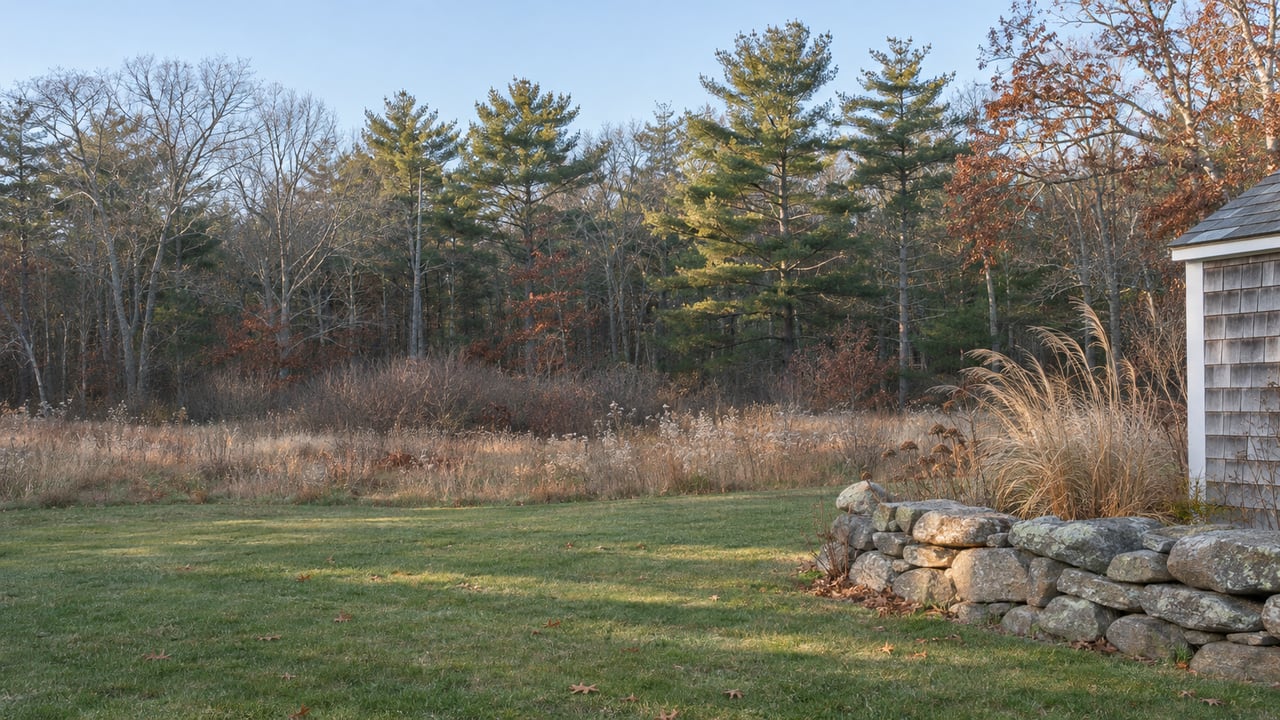
What could happen to the trees at the back of a Falmouth lot that borders the Central Maine Power corridor? The strip itself goes back about 75 years. CMP says it holds easement rights across the whole Section 180 corridor. They run 100 feet wide, 50 feet on each side of the existing centerline, and were "primarily acquired in the late 1940s and early 1950s."
That old strip now holds most of the current debate. CMP's Greater Portland Transmission Upgrades would add a new 115-kV line through town. After public comment, CMP changed its design and says the new line fits inside the existing right-of-way.
A 100-Foot Strip From the Truman Years
The project is before the Maine Public Utilities Commission as Docket No. 2025-00276. CMP dated the petition September 16, 2025. Phase 1 includes a new 12.2-mile, 115-kV line from Raven Farm in Cumberland to a new Bayside substation in Portland, plus about 20 miles of rebuilt 34.5-kV lines. CMP estimates Phase 1 at $546.97 million. The route passes through Yarmouth, Cumberland, Falmouth, Westbrook and Portland, according to CMP's project page.
Falmouth's part of the route follows lines that are already there. Section 180 is a 34.5-kV line running 10.5 miles from Raven Farm to Prides Corner. Section 180A is a 4-mile tap to East Deering. The new 115-kV line, called Section 262, would run from Raven Farm toward East Deering through these same corridors. The petition describes steel monopoles for Section 262 averaging 90 to 110 feet tall. The rebuilt 34.5-kV lines would use steel poles averaging 50 to 70 feet.
The First Design Needed 93 Neighbors. CMP Says the Second Needs None of Them.
The original petition planned to widen the corridor. Between Raven Farm and the 180A tap, the strip would have grown from 100 feet to 150 feet. That meant acquiring new easement rights from about 93 property owners, though CMP said no homes or commercial buildings would have to be taken.
CMP's October 13, 2026 letter to the Falmouth Town Council describes a different plan. After the project open houses in late 2025, CMP refined the design to use Hendrix spacer cable, which it calls "a compact wire technology." The letter says this keeps both lines inside the existing right-of-way.
| Petition design, Sept. 2025 | Refined design, per CMP's Oct. 13, 2026 letter | |
|---|---|---|
| Corridor width, Raven Farm to 180A tap | Expanded from 100 ft to 150 ft | Kept within the existing 100-ft right-of-way |
| New easement rights | About 93 property owners | Avoids the roughly 50 ft of added right-of-way |
| Wire configuration | Partial double-circuit structures shared with Section 180 | Hendrix spacer cable for both lines in 100-ft sections, one line in wider sections |
| Clearing | Corridor expanded and cleared by 50 ft | "Limited additional clearing" possible, final limits set by later engineering |
CMP presents the redesign as a way to reduce the effect on neighbors, and under it CMP no longer plans the added right-of-way the petition would have taken from about 93 owners. Under CMP's plan, the new work would happen within the existing 100-foot easements from the late 1940s and early 1950s, subject to the MPUC's decision. CMP's letter says how vegetation work inside that space would be decided:
"Final clearing limits will be established through detailed engineering studies, and vegetation removal will be limited to only what is necessary to construct, safely operate, and maintain the lines in accordance with the applicable clearance requirements."
The same letter says CMP's plan "does not include a project-specific property-value study." CMP says it compared routes based on reliability, engineering, use of existing corridors, effects on landowners and communities, constructability and cost. CMP also says an I-295 route was considered. That route would have required underground construction costing more than six times the overhead route. The refined design is CMP's stated position. The MPUC has not ruled on it.
Where the Corridor Meets Everyday Falmouth
If you know the strip is there, it's easy to place on a map. In its review, Falmouth town staff listed these places along or near the corridor:
- The northern wooded edge of the school campus and its athletic facilities, and the nearby Merrill property, which has been considered for future school expansion
- The McCann Trailhead on Falmouth Road and the Falmouth Road Pump Station
- West Falmouth Crossing, between Hannaford and Dunkin' Donuts
- McCann Preserve, Woods Road Community Forest and Ledges Preserve
- The River Point Conservation Area, several streams, and the Presumpscot River
The Alliance for Responsible Infrastructure, a resident group with intervenor status in the MPUC case, adds neighborhoods along Woods Road, Stapleford Drive, Ledgewood, Charlotte Drive and Country Lane.
Town staff also said the filing did not include site-specific pole locations or clearing plans, which made it hard to judge the effect on any one property. A buyer can find out whether the easement is on a lot, but not yet where the new poles will stand.
The Town Council acted on October 14, 2026. It approved a resolution opposing the certificate "as submitted" and urged review of the project's need and scale, other routes, non-wires alternatives, and the effects on private property, conserved land and the school campus. The resolution records residents' concerns about tree loss, neighborhood change and possible declines in property value. It also says residents did not get enough direct communication or time to review new information. The Press Herald reported the vote two days later.
Maine's Property Disclosure Law
Maine's property disclosure law, 33 M.R.S. §173, lists what a seller's disclosure statement must cover. The list includes "any known defects" and information on how the property is accessed. The law defines a "known defect" in §171 by its effect on value, health or safety, or the expected life of the premises.
How that statute applies to a specific property near the corridor, and what a seller should say about it, is a question for a lawyer. This post is general information, not legal or financial advice. Buyers and sellers should confirm their own situation with a Maine real estate attorney.
A Clock That Runs Into 2027
For anyone buying near the corridor this winter, the pace of the review matters as much as the design:
- September 2025. CMP files its petition.
- July 16, 2026. The MPUC deems the application complete. CMP says the review is expected to take about 12 months from there.
- September 16, 17 and 23, 2026. The MPUC holds technical conferences on CMP's testimony and on the non-wires alternatives coordinator's report.
- December 31, 2026. The date by which CMP's petition says it plans a separate Phase 2 filing.
- 2027. The expected MPUC decision. If approved, CMP estimates construction at three to four years.
Put those dates together and someone who closes on a corridor parcel this winter could own it for a year or more before the state rules, and then live through construction. Maine Public, reporting on the opposition building around the region, noted that Portland Mayor Mark Dion planned to testify in the MPUC case. Members of the public can read the record and submit comments through the MPUC case comment page for Docket 2025-00276. The Town of Falmouth posts updates as CMP and the Council exchange letters.
Reading a Corridor Parcel Before You Write an Offer
These questions apply to any listing within sight of the Section 180 or 180A lines:
- Is the easement recorded against this lot, and where does the centerline fall? CMP describes the Section 180 easement as 100 feet wide, 50 feet on each side of the centerline. A survey that plots it shows how much of the yard sits inside.
- Which section is it? The Raven Farm to 180A tap stretch is where the original plan added 50 feet. The stretch from the 180A tap to East Deering already had enough room for the new line, according to the petition.
- What does CMP say about clearing? CMP's letter leaves room for limited additional clearing inside the right-of-way.
- What's in the docket? Town staff said the filing did not include site-specific pole locations or clearing plans.
- How long are you holding? A three-to-four-year build after a 2027 decision affects a short hold differently than a long one, for owner-occupants and investors alike.
A Falmouth corridor parcel is easier to judge once the 1950s easement, the refined CMP design and the MPUC timeline sit side by side. If you're weighing a home near the Section 180 line, or deciding when to list one, schedule a consultation with Veronica Schneider.