If you've started shopping for property near Sebago Lake or Little Sebago Lake this year, you've probably heard the headline version of Maine's housing law: the state legislature banned single-family-only zoning in 2022, towns have to allow more units per lot now, and the housing shortage is finally getting a legislative fix. All of that is true. None of it applies to the water.
Windham is a useful town to watch on this because the town didn't just get swept along by the state mandate. It made a specific, documented choice in 2024 about where that mandate would land, and the choice was to keep it away from the shoreline. Understanding why changes how you should read every price and every "buildable lot" listing you see near the lake this fall.
The Law Everyone Heard About
In 2022, Maine's legislature passed LD 2003, a law that effectively banned single-family zoning statewide by requiring towns to allow more housing units per lot and legalize accessory dwelling units almost everywhere residential use is permitted. The idea was to force zoning changes in areas towns had already designated for growth, since those Growth Area boundaries came from each town's own comprehensive plan.
It didn't stay simple. In 2025, lawmakers passed LD 1829 to tighten the density requirements further, and towns with a town-meeting form of government, Windham among them, were given until July 2027 to bring their local ordinances into compliance. Then in 2026, LD 2173 walked some of that back, restoring limited rate-of-growth ordinances and pushing certain deadlines out again. Three sessions in a row, the legislature has been negotiating exactly how much control a town like Windham keeps over its own map.
What Windham Actually Did With That Mandate
Here's where it gets specific to this town. Windham's 2016 comprehensive plan had Growth Area boundaries that, according to the town's own planning documents, didn't line up cleanly with its actual zoning districts. Rather than leave that mismatch in place and let the state law apply broadly, the Windham Planning Board held a public hearing in March 2024 on an amendment that reduced the Growth Areas and expanded both the Rural Areas and a new Route 302 Transitional Area.
In plain terms: Windham looked at where it was legally required to allow denser housing and redrew the map to concentrate that requirement along Route 302, while shrinking the footprint where it applies elsewhere in town.
The Town Council wasn't quiet about how it felt regarding the follow-up law. In a September 2025 letter to the governor, five councilors registered their objection, with Councilor Bill Reiner describing the council's "displeasure toward LD 1829 which will remove town control on growth rates in growth zones." That's a town actively negotiating the terms of its own density mandate, not passively absorbing it.
Route 302 is also where the physical infrastructure is showing up to match the paperwork. A MaineDOT project underway reconstructs about a mile and a half of Route 302 and adds a multi-use pathway connecting side streets, the kind of investment that typically precedes, not follows, higher-density housing along a corridor. The zoning language and the road construction are pointing at the same stretch of town.
The Water Line the Legislature Never Touched
None of this reaches the lake, and that's by design in two separate ways. First, LD 2003's unit-per-lot mandates only reach inside a town's designated Growth Areas, the same boundaries Windham redrew in 2024 to shrink in favor of more Rural Area. Second, where LD 1829 does add a height bonus for affordable housing projects elsewhere in town, legal analysis published by the law firm Preti Flaherty notes it applies "other than in the shoreland zone and other limited at-risk areas," carving the shoreline out by name even within areas the mandate otherwise reaches.
Maine's shoreland zoning rules themselves predate LD 2003 by roughly five decades, adopted by Windham's Town Council in 1974, long before any of this legislative back and forth started.
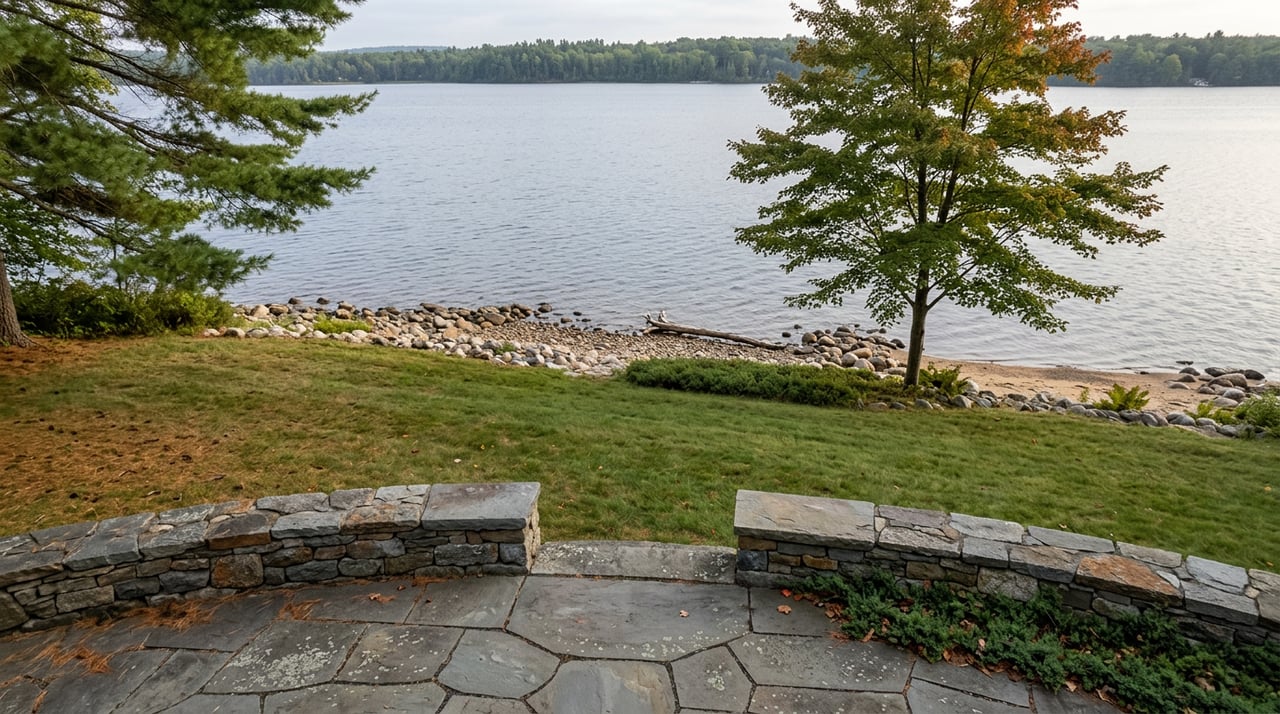
Windham's own shoreland ordinance still runs on numbers that have nothing to do with the current legislative fight. A standard residential lot within the shoreland zone requires 40,000 square feet and 200 feet of frontage per dwelling unit near a great pond like Sebago or Little Sebago Lake. Even a nonconforming lot that gets reconfigured to bring it closer to compliance can only shrink down to 100 feet of frontage and 20,000 square feet, a floor that's still well above what a town-meeting municipality is now required to allow inland.
Here's the shape of it side by side:
| Where | Minimum lot size per dwelling | Path under the new density law |
|---|---|---|
| Route 302 Growth/Transitional corridor | Set by town zoning, now subject to LD 1829's added-unit mandate | Actively expanding; comp plan redraw plus active MaineDOT road project |
| Shoreland zone (Sebago Lake, Little Sebago Lake frontage) | 40,000 sq ft / 200 ft frontage standard; 20,000 sq ft / 100 ft floor for reconfigured nonconforming lots | Outside designated Growth Areas; height-bonus provision explicitly excludes the shoreland zone by name |
The same legislative session that's loosening lot rules ten minutes inland is, by its own text, leaving the lakefront exactly where it's been since the shoreland ordinance was first adopted.
What This Actually Means If You're Comparing Towns
If you're underwriting a property with future unit potential in mind, the corridor is where the zoning trend favors you, not the shoreline. A parcel near Route 302 sits inside a town that has committed, through its own comprehensive plan and a state road project, to absorbing more density there over time. A parcel on Sebago or Little Sebago Lake sits inside a rule set that the reform was never allowed to touch, which means the scarcity you're seeing isn't a temporary supply crunch working itself out. It's a structural feature of the zone.
That distinction matters more than the town-wide sale price you'll see quoted anywhere, because a single town-wide number is blending two markets operating under two different regulatory regimes. As of August 2026, Windham's median list price sat near $540,000, down roughly 8 percent from a year earlier, while the trailing twelve-month median sale price across town ran closer to $520,000, up about 9 percent over that same window. A list price falling while a trailing sale median rises in the same town isn't a contradiction to untangle so much as a sign that a single town-wide figure is quietly averaging a Route 302 starter home against a Sebago Lake camp, two lots that answer to entirely different zoning rules.
If you're comparing Windham against other Sebago-area towns for a lake purchase, the more useful question isn't what the town's median did last quarter. It's whether the specific lot you're looking at sits inside the 250-foot shoreland buffer, because that line determines whether the last four years of state housing reform apply to it at all.
Common Questions
Does LD 1829 let me add a second unit on my Sebago Lake or Little Sebago Lake property? Not automatically. The added-unit mandates reach inside a town's designated Growth Areas, and Windham's 2024 comprehensive plan amendment moved more of the town, including its shoreland-adjacent land, into Rural Area instead. A lakefront lot is still governed by the shoreland ordinance's 40,000-square-foot, 200-foot-frontage standard rather than the new statewide density rules.
Will Windham's Route 302 corridor eventually feel like a denser neighborhood? The town's own 2024 comprehensive plan amendment and the active MaineDOT reconstruction project both point that direction, though the pace still runs through local site plan and subdivision review, which takes time regardless of what the state mandates.
Should I expect lakefront lot supply to loosen up as Windham finishes implementing the law? No. The shoreland exemption means the reform was never going to expand what's buildable near the water. If anything, the town's decision to shrink its Growth Areas elsewhere makes the corridor and the shoreline diverge further, not less.
Windham's zoning fight is still being negotiated in Augusta, but the shoreland line around Sebago and Little Sebago Lake has stayed remarkably steady through all three rounds of it. If you're weighing a lakefront purchase, an investment parcel near Route 302, or trying to figure out which side of that line a specific lot falls on, Veronica Schneider can walk you through what the current rules actually allow on a given property before you make an offer. Schedule a consultation to get the specifics for your address.